


 UK
UK  Two white Business Cards with embossed text reading ‘MADE WITH LOVE,’ slightly overlapping on a teal background

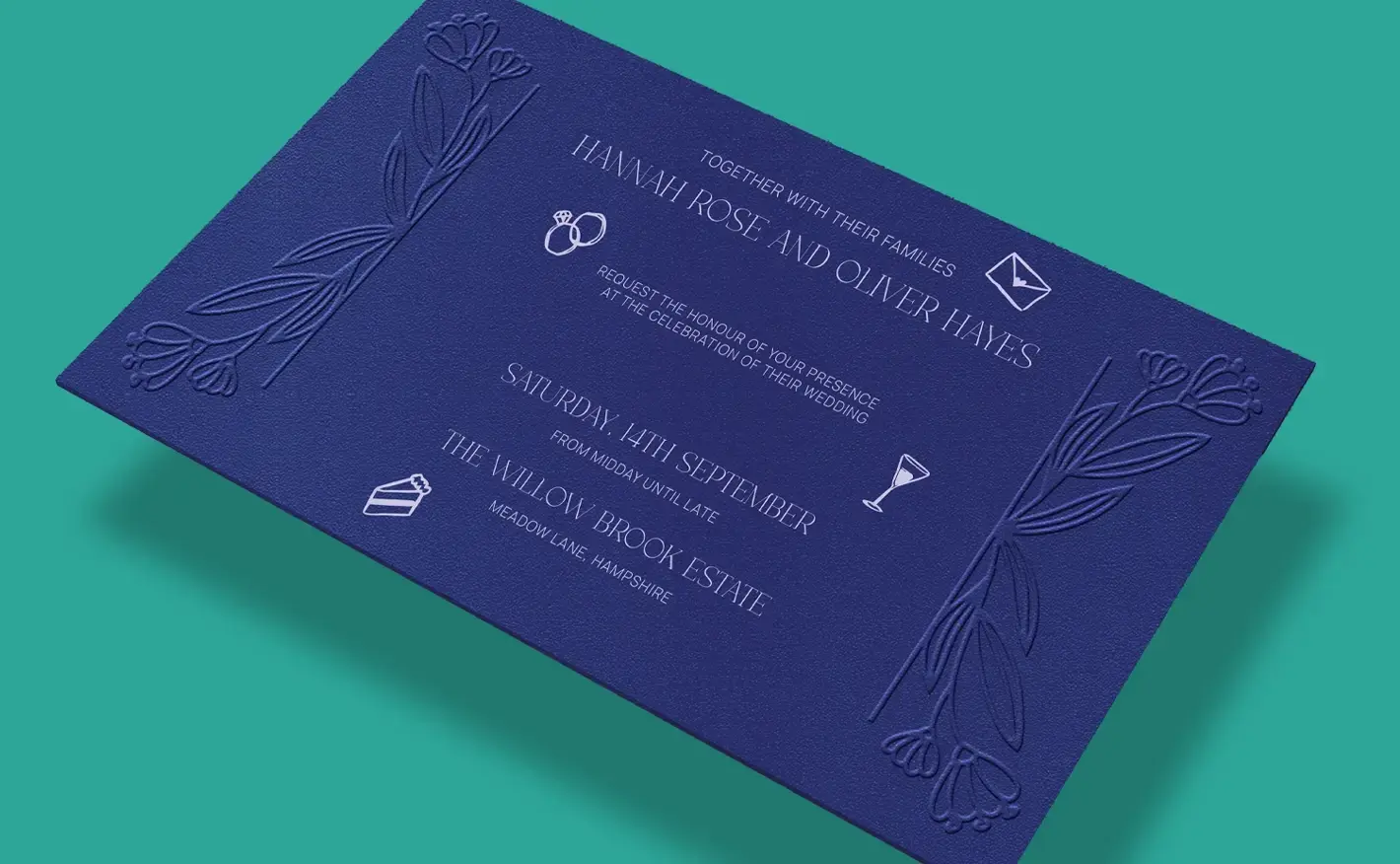 Dark blue Wedding Invitation featuring raised, embossed floral detailing along both edges, with light text announcing the wedding of Hannah Rose and Oliver Hayes
 Embossed
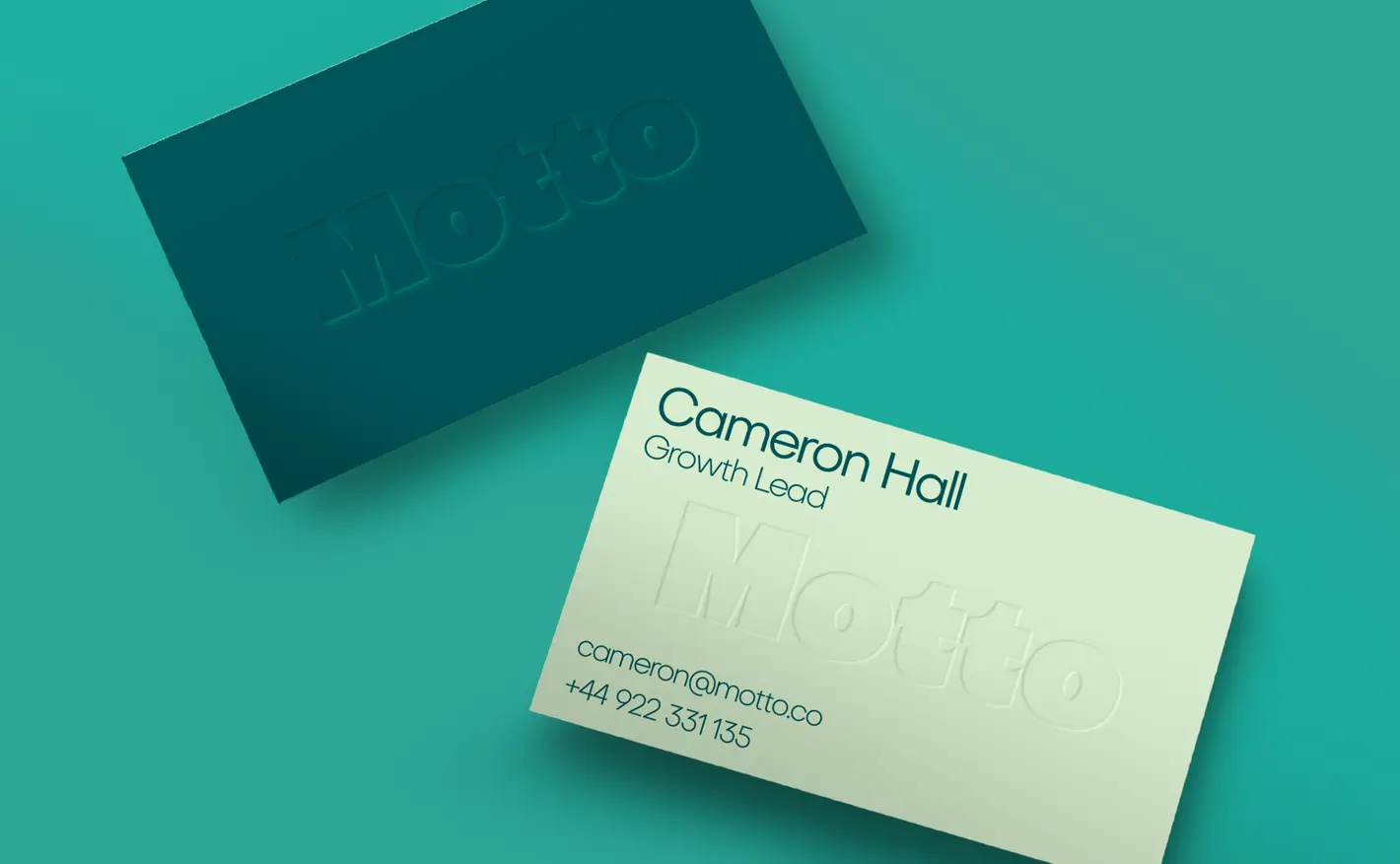 Two Business Cards on a teal background, both featuring embossed “Motto” branding, with contact details on one.
 Debossed
 A tablet on a purple background displaying a logo design that reads ‘The Party Co.’ inside an artwork design interface
 What does embossed mean?
What does debossed mean?
Which stocks work best for emboss and deboss?
For the best results, different paper weights suit each technique:
Stock recommendations:
- Debossing: Thick stocks of 300gsm or more
- Embossing: Lighter stocks, ideally under 200gsm
- Embossing and debossing are not compatible with digital foiling. If you'd like to include foiling on your print, get in touch with our Bespoke Team who can advise on the best solution.
- Blind embossing or debossing (without ink or foil) is the most eco-friendly choice, as it avoids solvents or pigments.
- Embossing and debossing blocks (the stamp made to press your design) can be reused for repeat orders, helping to reduce future waste and costs.
How do I setup my artwork for emboss or deboss?
To achieve the best possible result with embossing or debossing, it’s important your artwork is set up correctly. Please follow these guidelines when preparing your files:
You’ll need to supply three PDF files:
- A full artwork version – a file of your complete design, showing both the emboss/deboss areas and the CMYK printed areas.
- An emboss/deboss-only version – a file showing only the areas of the design that should be embossed or debossed, set to 100% black in CMYK.
- A print-only version – a file containing only the CMYK artwork, with all emboss and deboss elements removed.
Artwork setup tips:
- Minimum font size: 8pt for clear detail
- File type: Vector files are recommended for accuracy
- Artwork style: Bold text and shapes work best
- Download our guide for full artwork setup instructions
Does it show on the back of the paper?
Embossing and Debossing will usually be visible on the reverse side of the paper.
Because the design is pressed into the stock using pressure, the paper is physically shaped during the process. On thicker papers this reverse impression is often subtle, but it can still be noticeable.
If your design needs to look completely clean on both sides (for example, double-sided stationery), we recommend considering this carefully when choosing embossing or debossing.
Is there a setup cost for embossing/debossing?
Yes, embossing and debossing require a custom metal die (sometimes called a block), which means there is a one-off setup cost per design. This cost covers the creation of the die used to press your design into the paper. We keep the dies on file, so the initial set-up cost won't apply to repeat orders of the same design.
What does embossed mean?
What does embossed mean?
What does debossed mean?
What does debossed mean?
Which stocks work best for emboss and deboss?
Which stocks work best for emboss and deboss?
For the best results, different paper weights suit each technique:
Stock recommendations:
- Debossing: Thick stocks of 300gsm or more
- Embossing: Lighter stocks, ideally under 200gsm
- Embossing and debossing are not compatible with digital foiling. If you'd like to include foiling on your print, get in touch with our Bespoke Team who can advise on the best solution.
- Blind embossing or debossing (without ink or foil) is the most eco-friendly choice, as it avoids solvents or pigments.
- Embossing and debossing blocks (the stamp made to press your design) can be reused for repeat orders, helping to reduce future waste and costs.
How do I setup my artwork for emboss or deboss?
How do I setup my artwork for emboss or deboss?
To achieve the best possible result with embossing or debossing, it’s important your artwork is set up correctly. Please follow these guidelines when preparing your files:
You’ll need to supply three PDF files:
- A full artwork version – a file of your complete design, showing both the emboss/deboss areas and the CMYK printed areas.
- An emboss/deboss-only version – a file showing only the areas of the design that should be embossed or debossed, set to 100% black in CMYK.
- A print-only version – a file containing only the CMYK artwork, with all emboss and deboss elements removed.
Artwork setup tips:
- Minimum font size: 8pt for clear detail
- File type: Vector files are recommended for accuracy
- Artwork style: Bold text and shapes work best
- Download our guide for full artwork setup instructions
Does it show on the back of the paper?
Does it show on the back of the paper?
Embossing and Debossing will usually be visible on the reverse side of the paper.
Because the design is pressed into the stock using pressure, the paper is physically shaped during the process. On thicker papers this reverse impression is often subtle, but it can still be noticeable.
If your design needs to look completely clean on both sides (for example, double-sided stationery), we recommend considering this carefully when choosing embossing or debossing.
Is there a setup cost for embossing/debossing?
Is there a setup cost for embossing/debossing?
Yes, embossing and debossing require a custom metal die (sometimes called a block), which means there is a one-off setup cost per design. This cost covers the creation of the die used to press your design into the paper. We keep the dies on file, so the initial set-up cost won't apply to repeat orders of the same design.
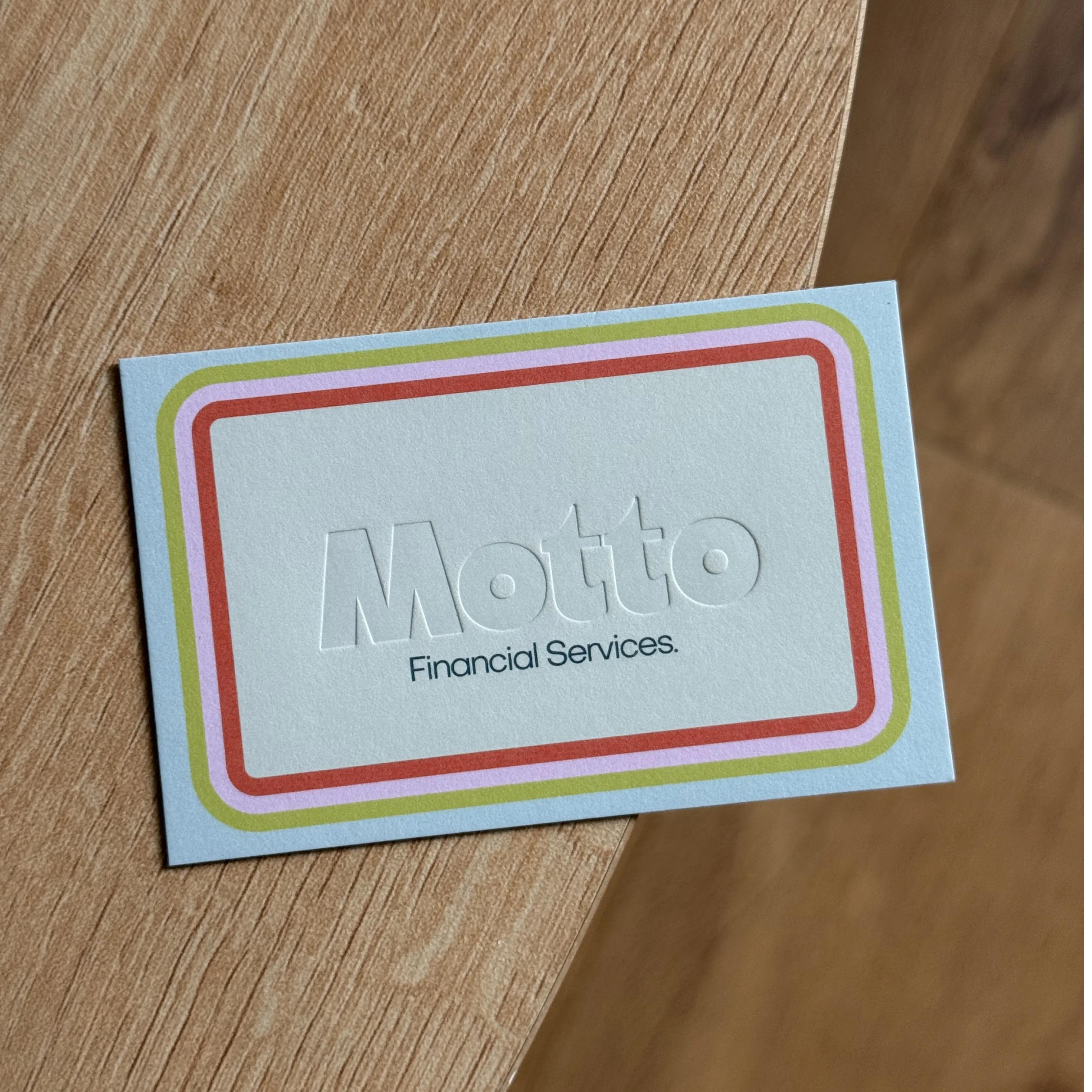 Debossed blue Business Card for Motto Financial Services, featuring a tri-colour border in green, yellow, and red
 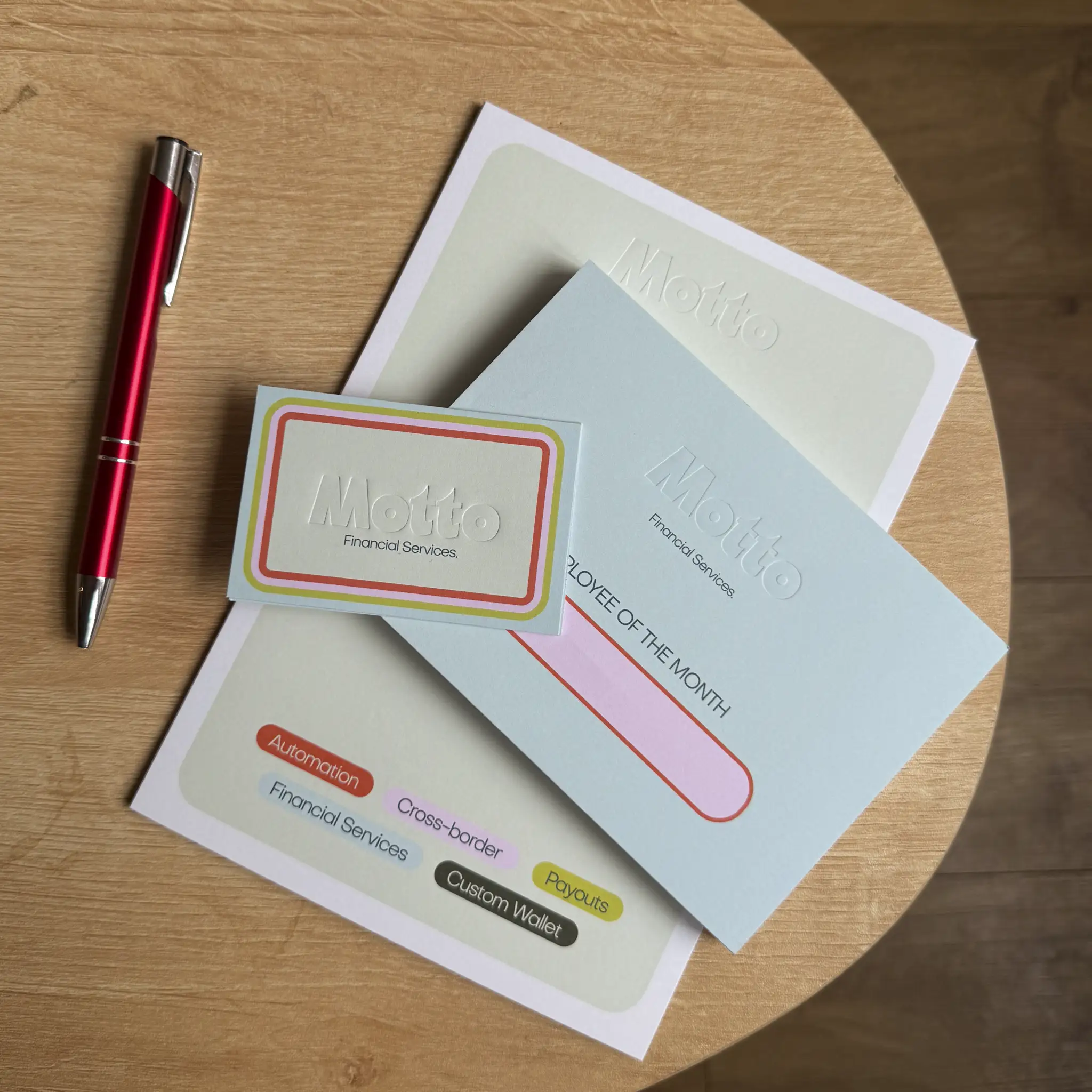 A red pen lies next to a collection of "Motto Financial Services" stationery on a wooden table, featuring a certificate and business cards with the company name "Motto" deeply pressed into the thick, pale mint and light blue cardstock using a tactile debossing technique.
 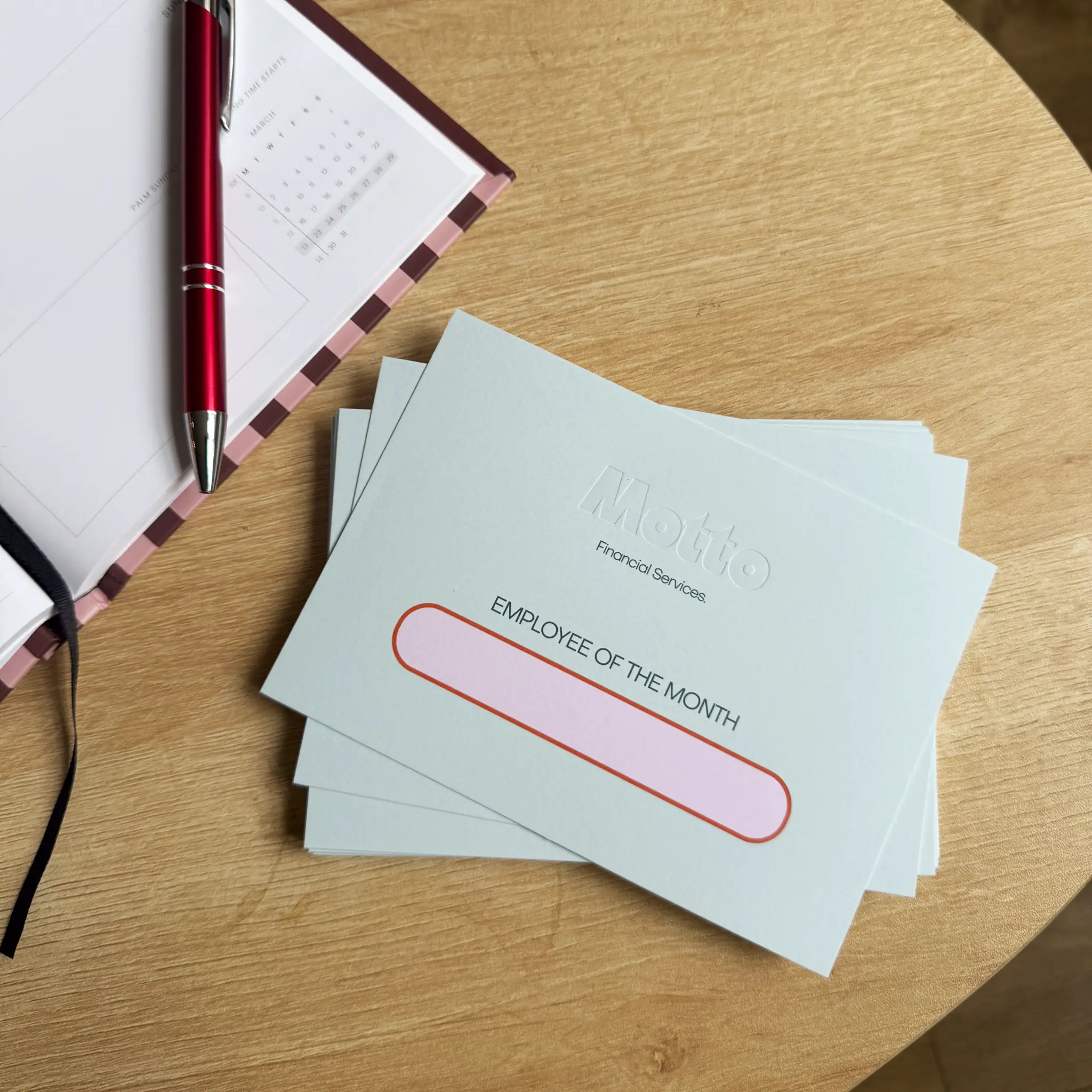 A stack of pale mint "Employee of the Month" cards rests on a wooden desk next to an open planner, featuring the "Motto Financial Services" logo deeply pressed into the centre of the thick cardstock using a crisp, inkless debossing technique.
 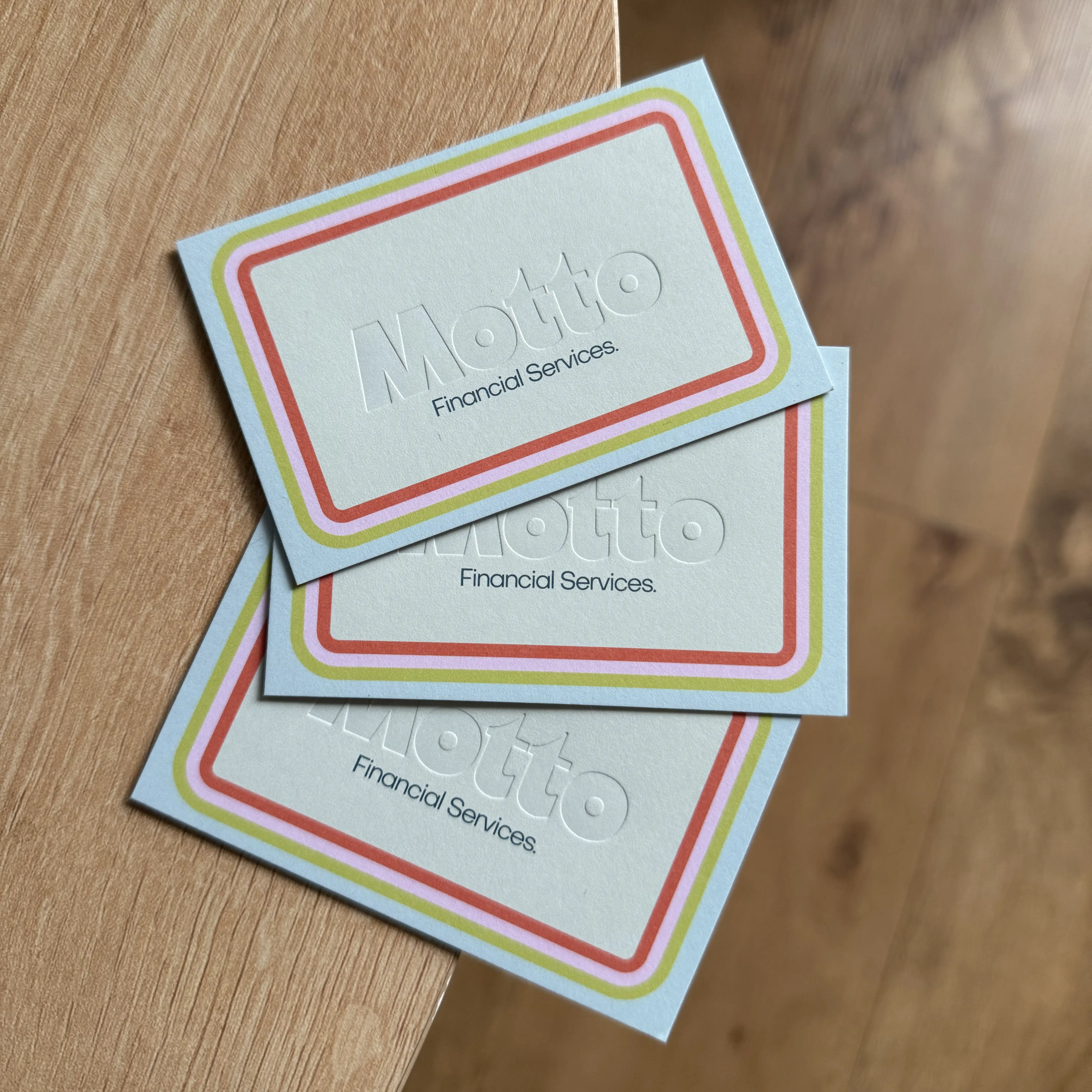 A fanned-out trio of pale mint business cards for "Motto Financial Services" rests on a wooden surface, featuring the "Motto" logo deeply debossed into the centre, framed by a vibrant, multi-coloured border of orange, pink, and yellow lines.
 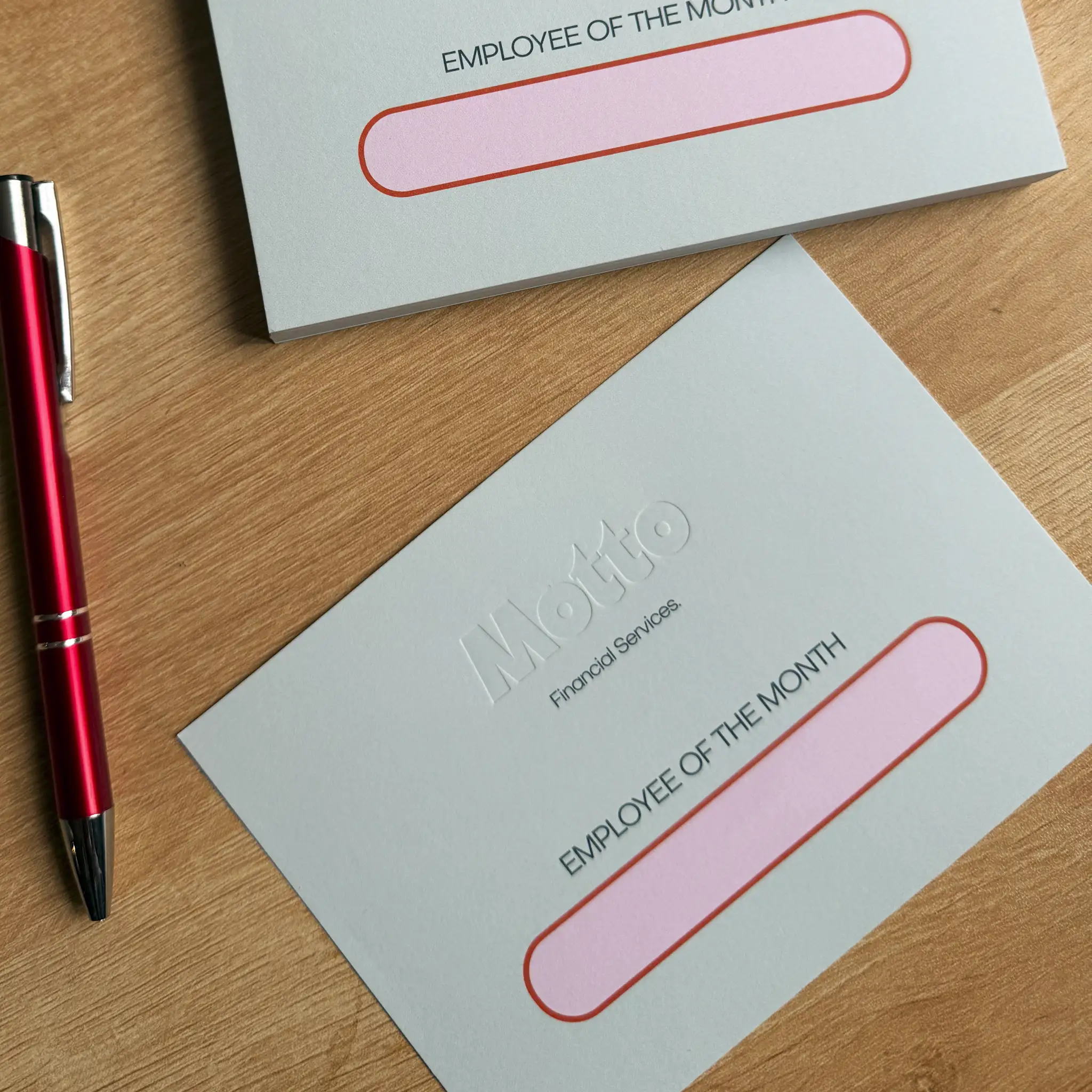 A close-up shows a red pen next to a pale mint "Employee of the Month" card, featuring the "Motto Financial Services" logo deeply debossed into the centre, creating a tactile, inkless impression that catches the light and casts soft shadows on the thick cardstock. Debossed blue Business Card for Motto Financial Services, featuring a tri-colour border in green, yellow, and red A red pen lies next to a collection of "Motto Financial Services" stationery on a wooden table, featuring a certificate and business cards with the company name "Motto" deeply pressed into the thick, pale mint and light blue cardstock using a tactile debossing technique. A stack of pale mint "Employee of the Month" cards rests on a wooden desk next to an open planner, featuring the "Motto Financial Services" logo deeply pressed into the centre of the thick cardstock using a crisp, inkless debossing technique. A fanned-out trio of pale mint business cards for "Motto Financial Services" rests on a wooden surface, featuring the "Motto" logo deeply debossed into the centre, framed by a vibrant, multi-coloured border of orange, pink, and yellow lines. A close-up shows a red pen next to a pale mint "Employee of the Month" card, featuring the "Motto Financial Services" logo deeply debossed into the centre, creating a tactile, inkless impression that catches the light and casts soft shadows on the thick cardstock. Debossed blue Business Card for Motto Financial Services, featuring a tri-colour border in green, yellow, and red A red pen lies next to a collection of "Motto Financial Services" stationery on a wooden table, featuring a certificate and business cards with the company name "Motto" deeply pressed into the thick, pale mint and light blue cardstock using a tactile debossing technique. A stack of pale mint "Employee of the Month" cards rests on a wooden desk next to an open planner, featuring the "Motto Financial Services" logo deeply pressed into the centre of the thick cardstock using a crisp, inkless debossing technique. A fanned-out trio of pale mint business cards for "Motto Financial Services" rests on a wooden surface, featuring the "Motto" logo deeply debossed into the centre, framed by a vibrant, multi-coloured border of orange, pink, and yellow lines. A close-up shows a red pen next to a pale mint "Employee of the Month" card, featuring the "Motto Financial Services" logo deeply debossed into the centre, creating a tactile, inkless impression that catches the light and casts soft shadows on the thick cardstock.
  Canva support with Printed.com